 Radio Free Earth
Radio Free Earth
Radio Free Earth
In Beyond Bigotry, Robert Ervin introduces the Four-Lens Framework — a practical method for examining how societies distribute risk, accountability, incentives, and opportunity.
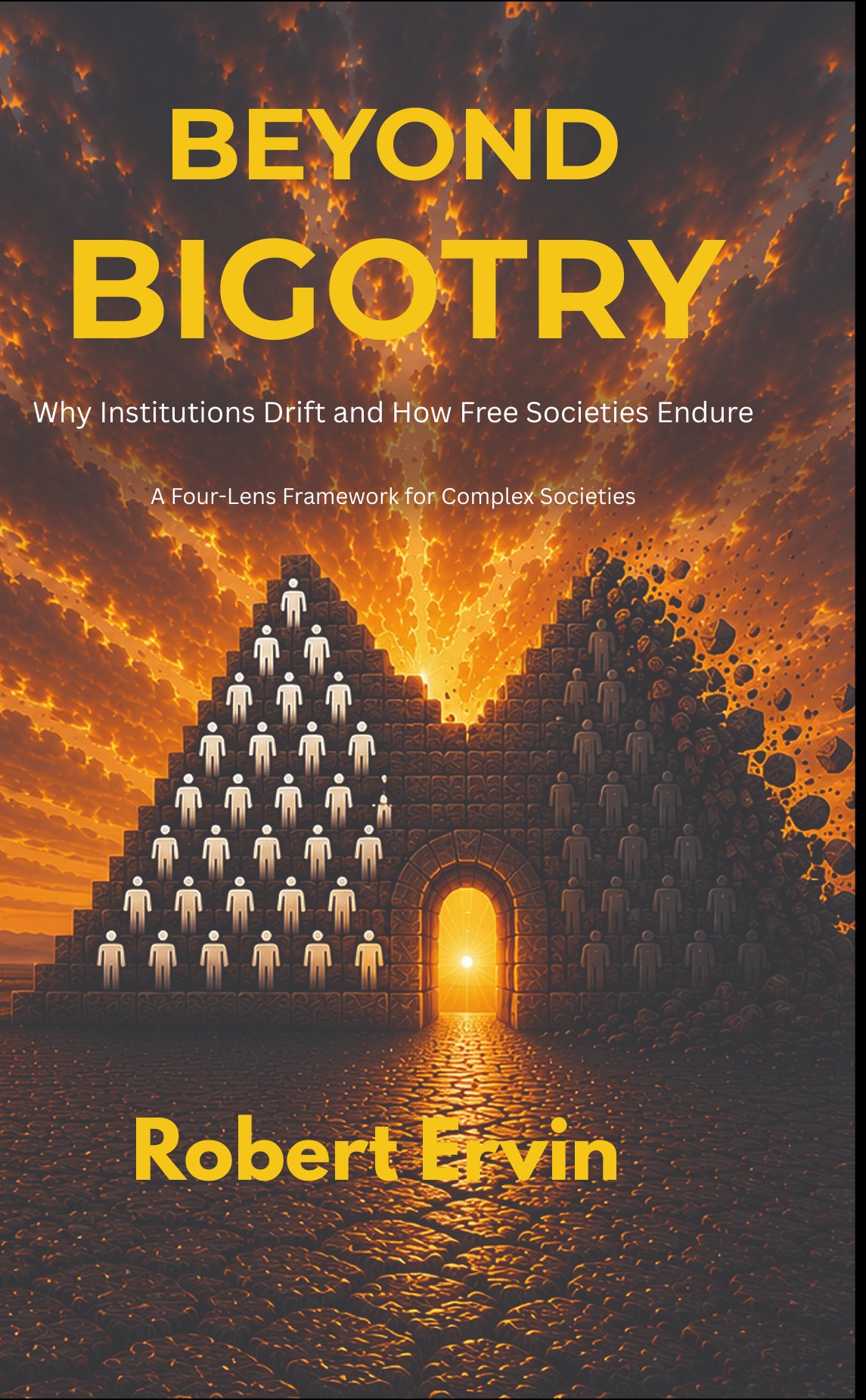
Rather than assigning blame or advancing ideology, the framework evaluates institutional systems through four recurring structural questions — the load-bearing piers of the argument.
How are risks distributed across populations when systems succeed or fail?
To what degree are decision-makers exposed to the consequences of their decisions?
Do institutional incentives reinforce long-term stability, or reward short-term concentration of advantage?
Do systems preserve pathways of movement across social and economic tiers, or restrict participation?
The framework begins with a presumption of Co-Equal Presumption — the idea that all persons possess equal moral standing prior to identity, status, wealth, or belief. Every chapter that follows asks an architectural question, not a moral one: if that is what we know, how did our institutions come to be built as though we didn't?
Why Institutions Drift and How Free Societies Endure
Drawing on history, law, economics, technology, and personal experience, Robert Ervin explores the structural patterns that shape institutions across cultures and generations — from structural drift to pluralist stability.
This book challenges readers to examine the systems around them, and the choices that determine whether those systems endure.
Before the Framework. Before the analysis. Before the history. There is a principle so ancient, so universally shared, so independently arrived at by virtually every civilization that has ever existed, that it can only be described as sacred: treat others as you wish to be treated. Do not do to others what you would not want done to you.
It is sacred not because any single religion declared it so — though nearly every religion has. It precedes religion. It precedes law. It precedes philosophy. It appears in the teachings of Confucius, in the Torah, the Talmud, the New Testament, the Quran, the Mahabharata, in Buddhist scripture, in the oral traditions of Indigenous peoples across multiple continents — not as borrowings from a common source, but as independent arrivals at the same recognition.
This book calls that recognition Co-Equal Presumption: every person possesses equal moral standing prior to identity, role, wealth, or classification. If that is what we know, if that is what we hold as sacred — how did institutions come to be built as though we didn't? That is not a philosophical question. It is an architectural one.
The South Africans at the Bar
I was twenty-something, bartending at a waterfront restaurant in Seattle, one of the popular ones, the kind that fills up on a Friday with people who feel good about where they've landed. A group of South Africans came in that evening — in town training on Boeing aircraft, pilots, professionals, men who carried themselves with the ease of people accustomed to being taken seriously.
They settled at the bar and, after a drink or two, began talking about mixed-race children. Specifically, about how they felt sorry for them — no real place in society, rejected by both sides. It was a tragedy, really. I kept doing my job. I did not tell them what I was.
A few minutes later my manager came over with a problem: a Black cook had been assigned to the sauté station, and the white cook responsible for stocking it had left it bare. My manager described it as a neutral staffing puzzle. I said what seemed obvious: the white cook was responsible. He should be treated accordingly.
The South Africans picked up their drinks and moved to a table across the room…
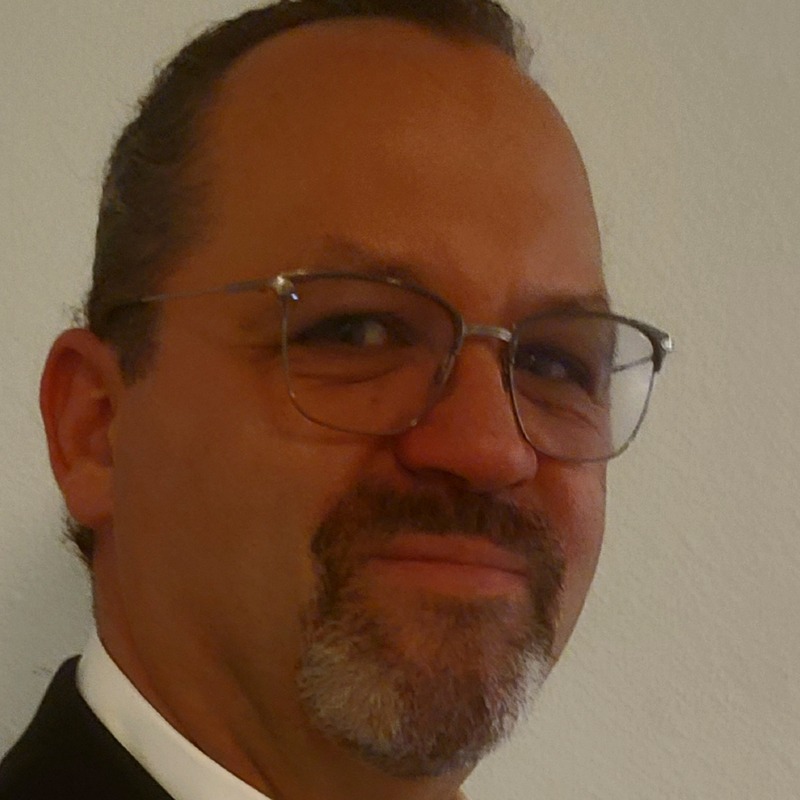
Robert Ervin is the author of Beyond Bigotry and the founder of Radio Free Earth. He lives and writes in Seattle, Washington.
Shaped by a childhood spent watching how institutions apply their own rules unevenly, Ervin writes from the conviction that most institutional drift is not driven by hatred — it's driven by structure. Understanding that structure, he argues, is the first step toward correcting it.
Beyond Bigotry builds on ideas first explored in an earlier work, Bigot, Non-Bigot, co-authored with Virginia Sylvester — distinguishing the bigoted context from the non-bigoted one that Beyond Bigotry later develops into the full Four-Lens Framework.
Beyond Bigotry is his first book, independently published by Radio Free Earth Publishing.
Beyond Bigotry is the first release from Radio Free Earth — alongside The Progress Report, a YouTube channel applying the same framework to current events.
Radio Free Earth's YouTube channel — video conversations and commentary applying the Four-Lens Framework to current events and institutions.
Coming soon →Radio Free Earth was co-founded by Robert Ervin and Virginia Sylvester, co-author of the earlier work Bigot, Non-Bigot.
More on the mission →Beyond Bigotry is where the Four-Lens Framework gets applied in full. The mission is bigger than the book: teaching people to ask these four questions of any institution, not just this one.
See the full mission →